Photographs from the world of science
Photographed on comission of various magazines, companies, foundations, research institutes and universities.

Photographed on comission of various magazines, companies, foundations, research institutes and universities.

Professor Dr. Katerina Harvati‐Papatheodorou
I photographed one of the most important scientists for the thematic issue on Neanderthals in the magazine GEO kompakt: Professor Harvati researches especially the emergence of anatomically modern humans and the palaeobiology of Neanderthals.
One should immediately recognize the subject and her field of research in the picture. That’s how this image idea came to be realized.

PanoLab, Max Planck Institute for Biological Cybernetics, Tübingen
Experiments on spatial perception, orientation and perception-based actions. The images are projected over almost the entire human visual field: the researchers therefore achieve very realistic simulations and it is possible to systematically examine each area of the visual field for its relevance to human perception.
The researchers’ work situation seems to be well depicted here, with a very natural light. But that is not the case at all. To create exactly this mood, a somewhat elaborate lighting setup with several lights is necessary.


Professor Dr. Monika Hasenbring
Professor Dr. Monika Hasenbring researches the topic of back pain and is head of the Department of Medical Psychology and Medical Sociology at the Ruhr University in Bochum.
For this portrait, we thought of an idea that would be a good way to visualise the topic of back pain. At the institute we found a spine model and the torso with a view of the spine and one with back extensor muscles.


Prof. Dr. Jörg Wrachtrup
Prof. Dr. Jörg Wrachtrup, 3rd Institute of Physics at the University of Stuttgart. Prof. Dr. Jörg Wrachtrup’s team uses lasers for research to develop nano-carrier systems. For a portrait for the Volkswagen Foundation, I photographed him at the optical table with a confocal laser microscope.


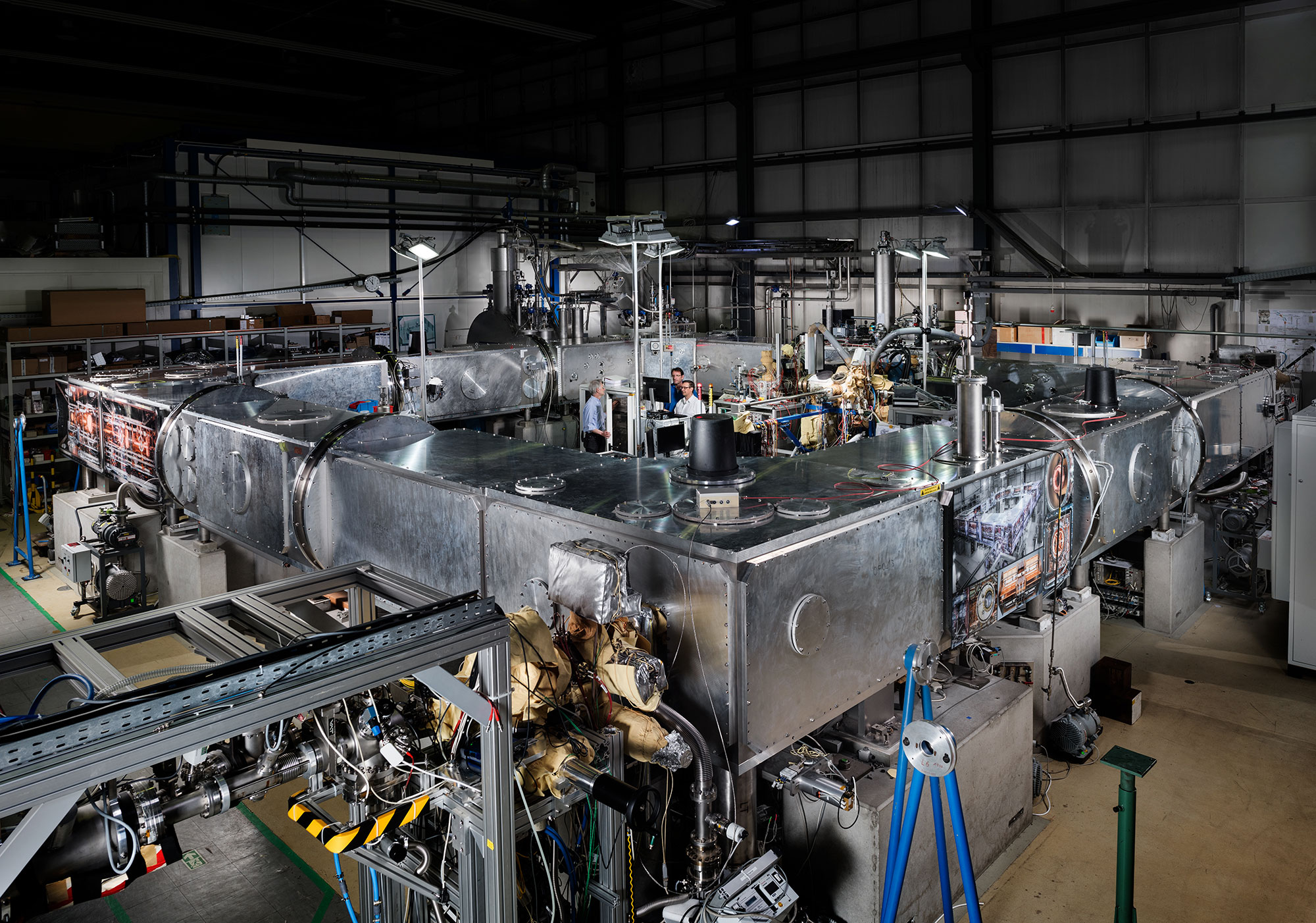
Storage ring CSR
Storage ring CSR at the Max Planck Institute for Nuclear Physics in Heidelberg. Storage ring for ultracold molecules in which the chemical conditions of space can be mimicked in the laboratory. Dr. Robert von Hahn, Prof. Dr. Andreas Wolf and Dirk Kaiser conduct research there.
I have rarely come this close to space.


Oberwolfach Research Institute for Mathematics.
Professor Dr András Némethi from the Hungarian Academy of Sciences in Budapest at the mini-workshop: Interactions between low-dimensional topology and complex algebraic geometry.
I photographed the mathematicians from all over the world for two days at the MFO for a report by GEO magazine. I rarely met such nice and understanding scientists. Until then, I thought I had a decent education in mathematics, but after these two days I had to admit to myself that I had understood nothing – but nothing at all – in their workshops.


From here, you can easily navigate to all the different portfolios and image series.