Berthold Steinhilber Photography

German bedroom

German Bedrooms

The Culture of Bedrooms

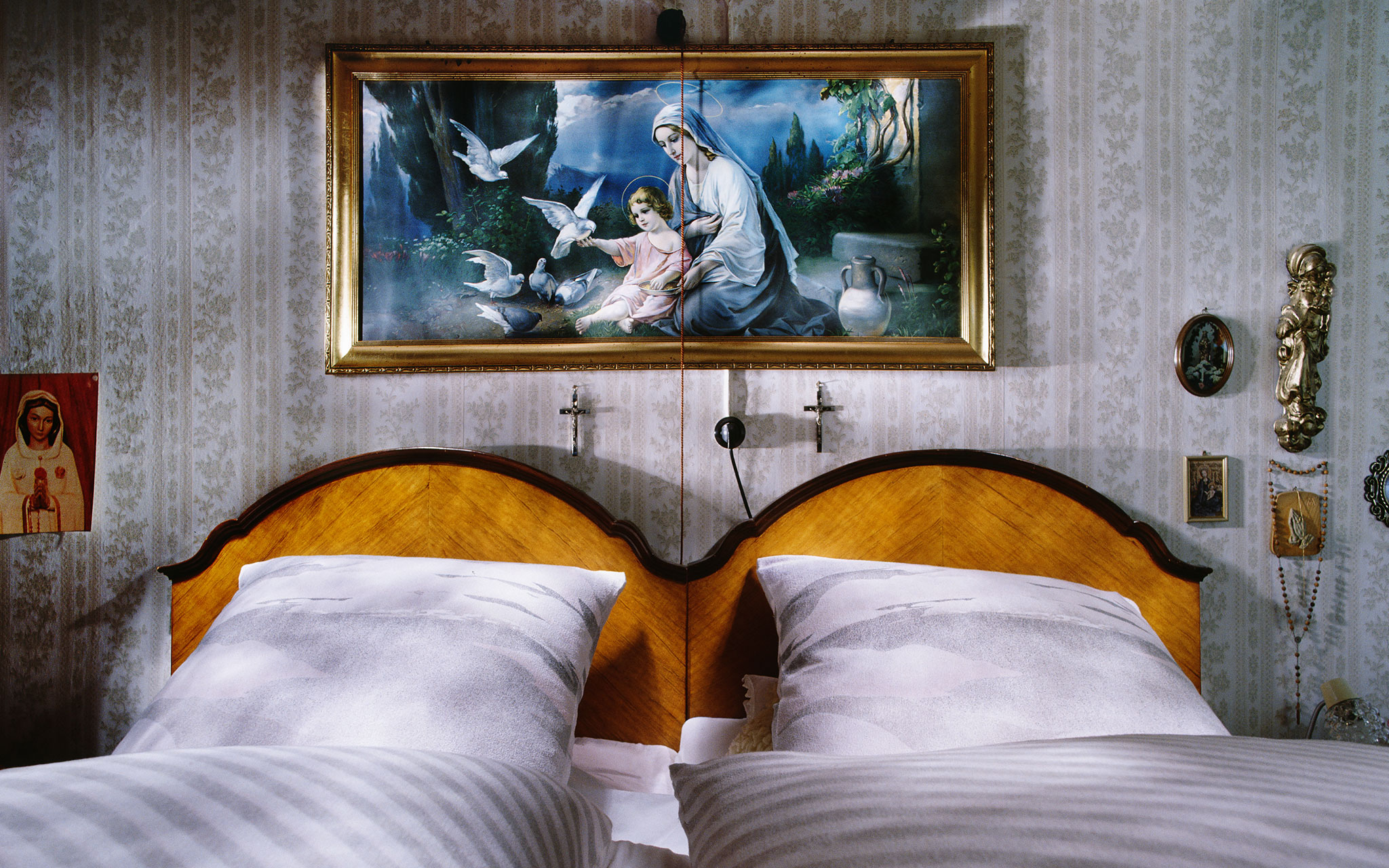
My grandmother’s bedroom must have been something of a sacred place. As a child, you were not allowed to enter it. Only in very rare exceptional cases, perhaps when grandmother was looking for something, were you allowed to enter this room. But then it turned into a magical place. The large mirror of the Frisian chest of drawers distorted one’s own image, below the hairbrushes, hair clips and many never-before-seen objects, unfamiliar smells of unfamiliar soaps, heavy drawers and then the huge bed with the large print of the young Mary with the baby Jesus above it. An adventure.
Many years later, grandma had long since lived with us, she allowed me to photograph this room…. Thus began the story of how I came to the “Room of Secrets” and started photographing bedrooms.

First I photographed bedrooms from my grandmother’s generation, that is, from the 1930s and 1940s. Many of the bedrooms were in their original condition, just as the then young couple had once furnished them after their marriage. The same wallpaper, the same picture and the same bed linen.

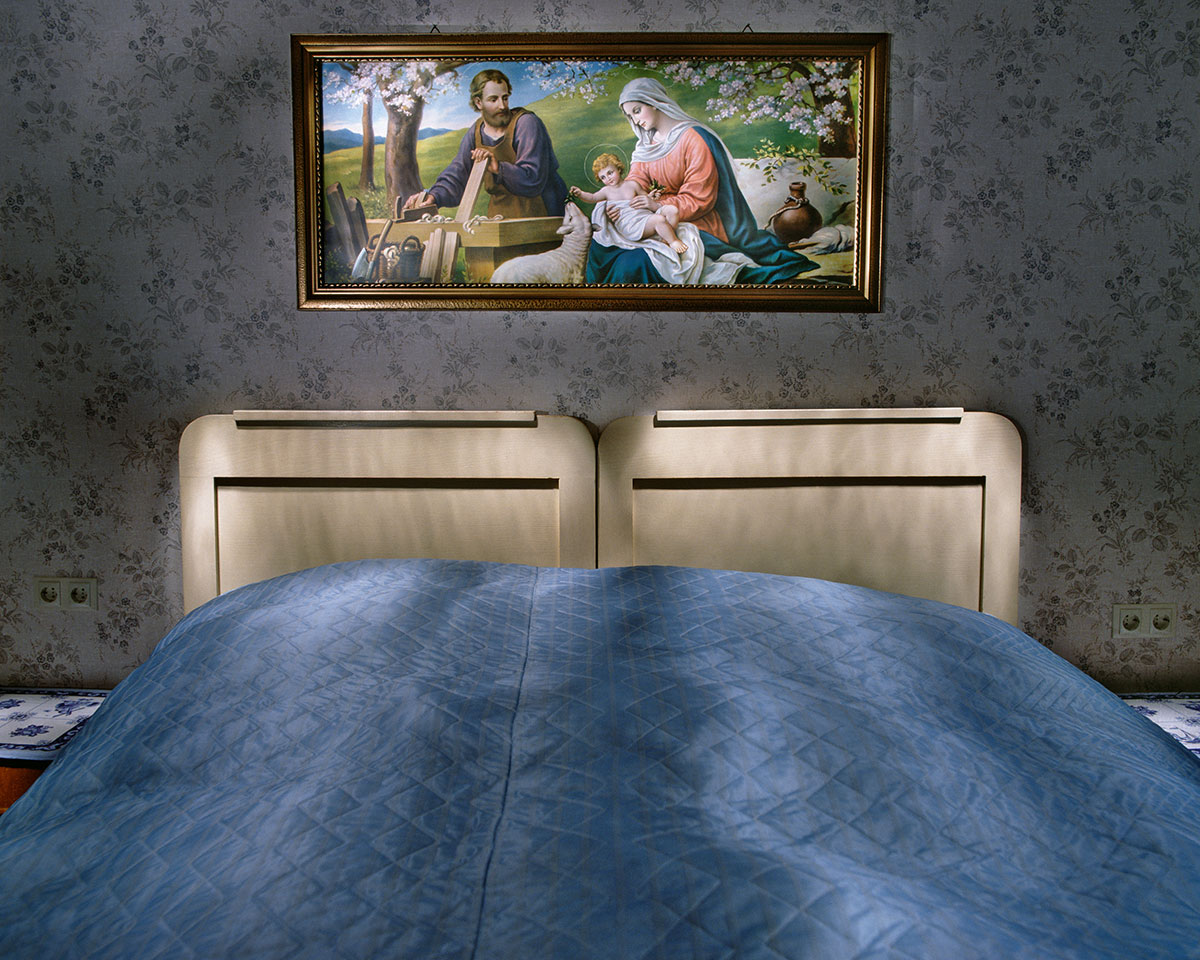
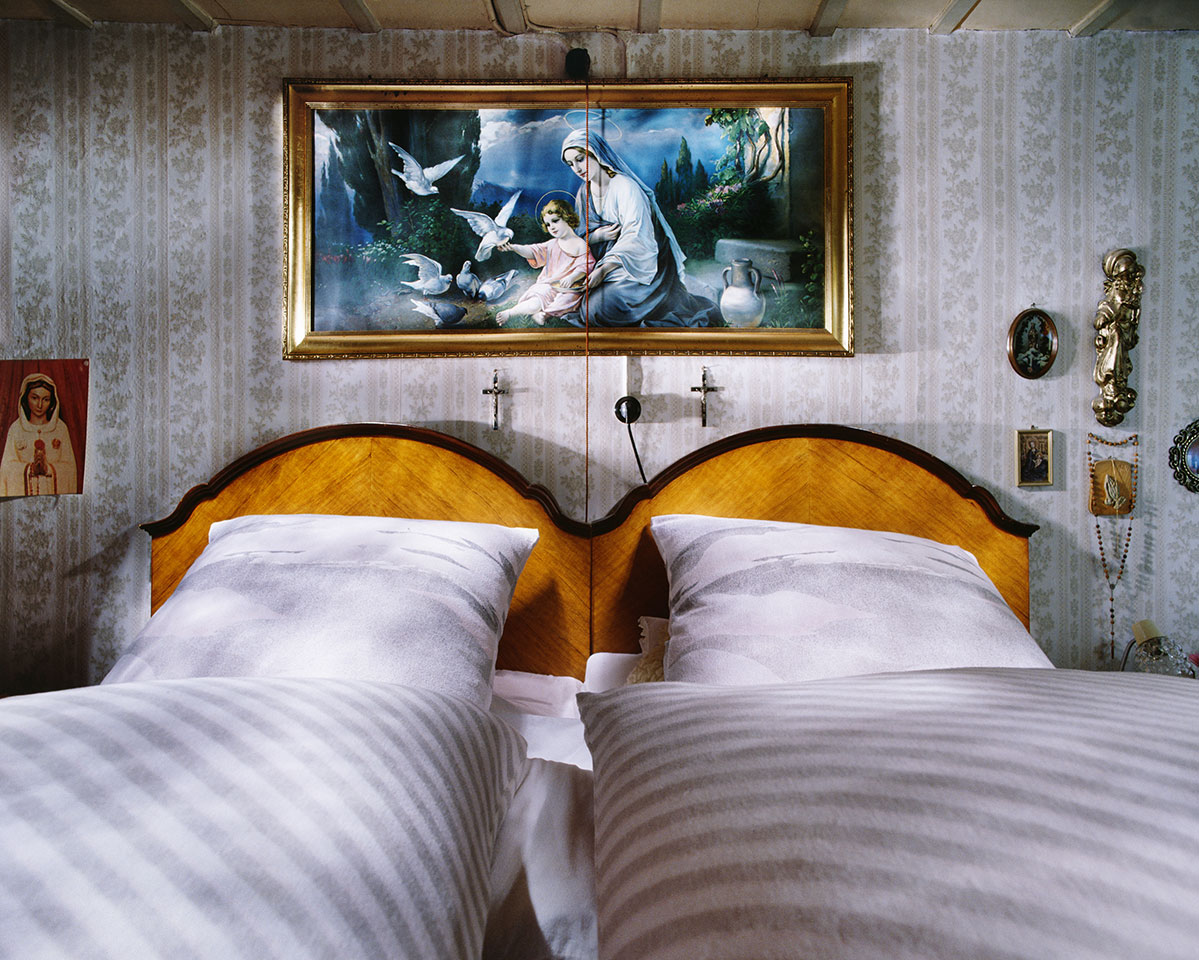
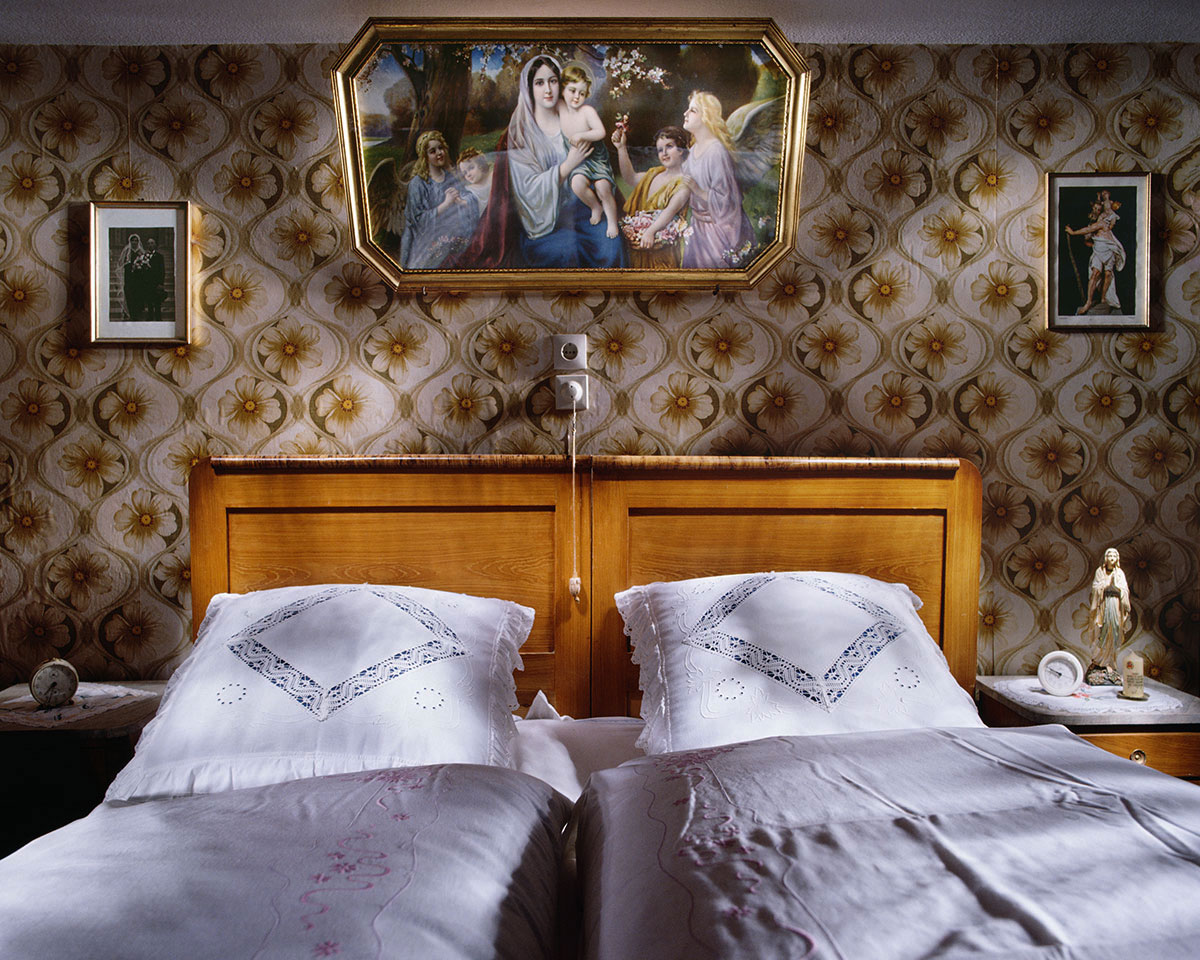
The picture behind the bed on the wall indicates the denomination of the couple: Catholics chose a picture with a depiction of Mary, while Protestants preferred pictures with motifs of Jesus and angels. The pictures were very often sold by travelling salesmen who had up to 10 pictures with religious motifs on offer.

I had noticed that the woman usually slept on the right side of the bed (on the left in the picture) and the man on the left. Often there were small crosses hanging on the wall, which the couple had received for their wedding and which went with them on their last journey.
In many pictures, the alarm clock indicates the time of death of the spouse. Sometimes the bedding of the deceased was removed, sometimes the bed was left as it was.
Many of the 80 to 90-year-old owners did not think of replacing the bed with modern beds; only health reasons or the loss of the partner could change this.
Schlafzimmer von 1933

Bedroom from 1933.

When I look at the photograph today, I see a room from my grandparents’ generation, something that no longer exists today, a picture from the »deep past«.
In retrospect, the room seems to me almost like a museum, a form of modern archaeology with signs that perhaps not all of us understand any more and I myself more ethnographer than photographer.

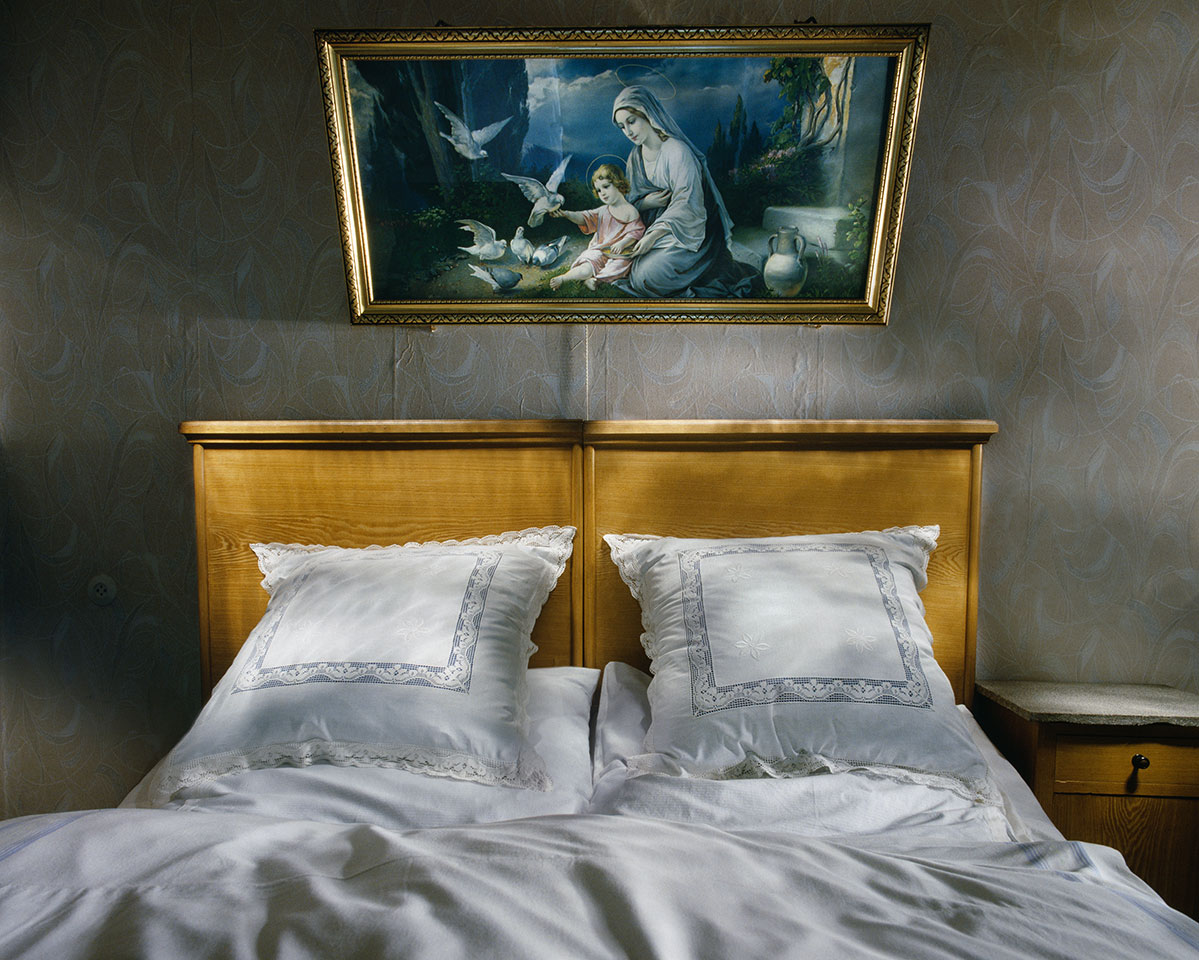
Schlafzimmer von 1937

Bedroom from 1937

The local carpenter made the bed. Above the bed hangs a gold stucco frame with an oil print of »Mary with the Child surrounded by angels«.
The room was very low, the image had to be hung at a slight angle accordingly.

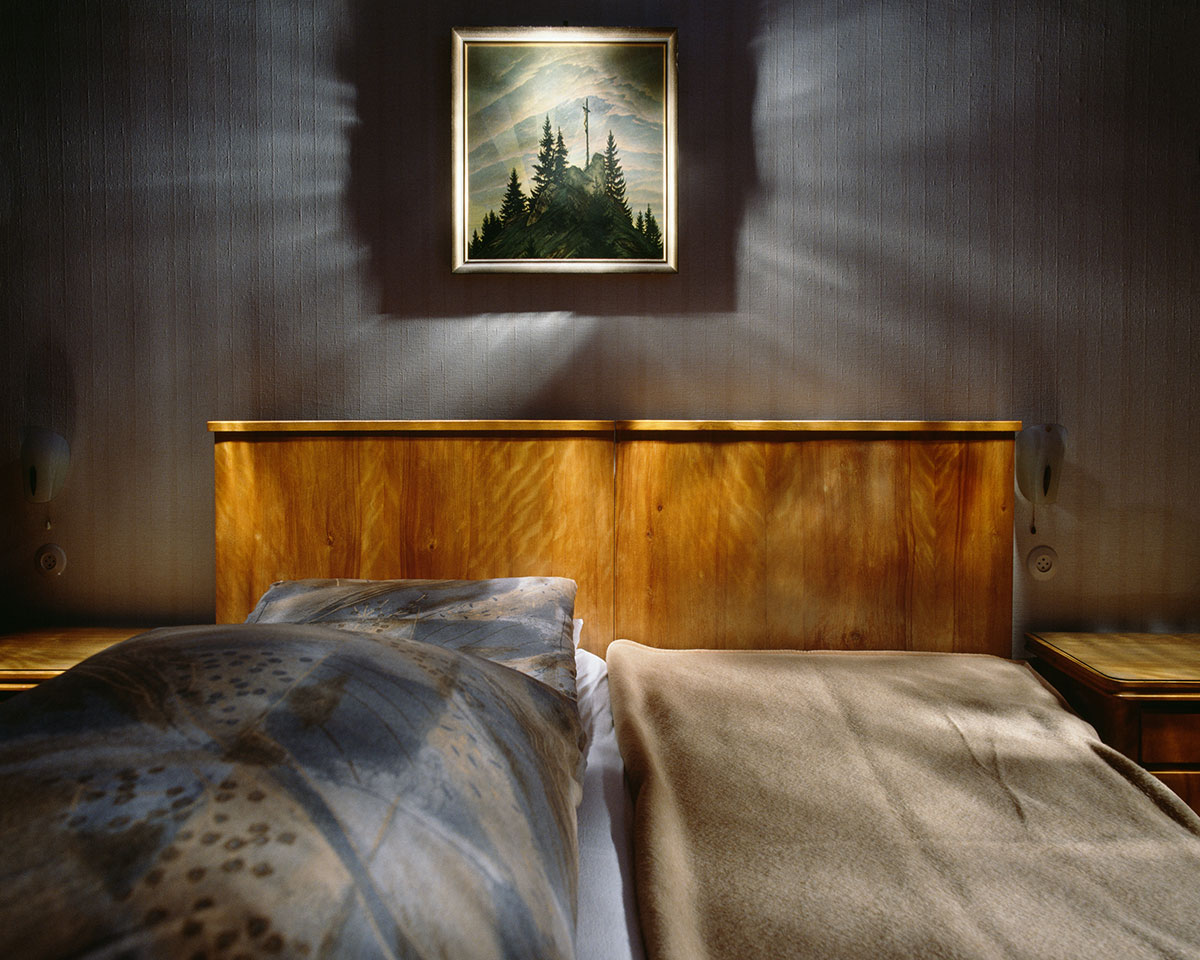
Schlafzimmer von 1941 mit Caspar David Friedrich Bild

Bedroom from 1941

One bed is not used, it is that of the deceased husband. Above the bed hangs a framed art print of Caspar David Friedrich’s painting »The Cross in the Mountains«.
While photographing it, I had the idea of what it would look like if the rays of light continued outside the frame. I photographed four to five variations and found this one very successful.

Schlafzimmer von 1932

Bedroom from 1932

Above the bed hangs a print »Dove Madonna« by Giovanni, a pseudonym of the Austrian painter Josef August Untersberger, who produced well-known bedroom paintings until the 1920s.
It is the first photograph in the series: my grandmother’s bedroom.

Schlafzimmer von 1941 - Sommerbett

Bedroom from 1941 – half of the bed used in summer.

Schlafzimmer von 1941 - Winterbett

Bedroom from 1941 – half of the bed used in winter.

"In the centre of the room, peaceful and imposing, stands the bed, a powerful symbol of a harmonious married and family life."

Pascal Dibie
“The cultural history of the bedroom”

Bedroom from 1934

Bedroom from 1934

Schlafzimmer von 1941 wurde in den 1980er Jahren erneuert

Bedroom from 1941

The bedroom was modernized in the 1980s

Schlafzimmer von 1939

Bedroom from 1939

“In addition to the telephone wake-up service, whose brutality is unparalleled, one of the most traumatic devices remains the tinny alarm clock with a double bell mechanism, which, as soon as it starts rattling, begins to move and slide around on the smooth marble of the mantelpiece, in danger of falling down and shattering into a thousand pieces (such is its poor quality) if you don’t intervene immediately to stop its rampage.”

Pascal Dibie
“The cultural history of the bedroom”

Schlafzimmer von 1939

Bedroom from 1939

Three children slept together in this bed in the attic. The room was not heated even in winter.

Schlafzimmer 1920er Jahre
Schlafzimmer von 1928
Schlafzimmer von 1939
Schlafzimmer von 1920
Schlafzimmer von 1941
Schlafzimmer von 1966
Schlafzimmer von 1980
Schlafzimmer von 1938
Bett und Schlafzimmer von 1941
Schlafzimmer von 1940 mit modernem Bett von 1983

...what all developed from this

I photographed my first works about the bedrooms during my studies at the Dortmund University of Applied Sciences and Arts. I was awarded several prizes for them.
There was an award at the German Photography Prize of the Landesgirokasse in 1995. I also won an award at the prestigious Reinhard Wolf Prize in 1996, received a Kodak Young Photographer Award in 1996 and in England the German bedrooms work won second place in the Observer Hodge Award in 1997.

The series opened many unknown doors for me, but more than that, through experimenting with light and the constant development of this lighting technology, I entered new worlds of documentary photography that I could not have imagined at first and from which over the years the Lightworks series developed.

These Bedroom photographs have been with me all my professional photographic life and over the years I have photographed many other subjects around the theme of sleeping.

Here are a few selected bedrooms of the “Next Generation”.

Schlafzimmer der Nuller Jahre
Schlafzimmer der 2000er Jahre
Schlafzimmer der 1960er Jahre