Germany - a Journey through Time
Landscapes and Places of German History
Where do Germans come from, and what has shaped them?
This question was the starting point for working on this book. In developing the basic idea, I took the current state of the nation as my starting point: Germany today is a functioning and stable democracy that is held in high esteem internationally. General prosperity is high, but at the same time the concerns of many citizens are increasing. Globalisation and migration are unsettling people; some look to the future with concern, while others long for security and familiarity.
The question of what it means to be German has been with me since my youth. Back then, we hitch-hiked through France to the Mediterranean and were labelled “Les Boches” – a derogatory term for Germans that means something like ‘stubborn blockheads’. I wanted to get to know the whole history of the Germans as well as I could.
As the number of marches characterized by hatred and intolerance on the streets continued to increase in 2015, I began the “journey through time”. Where is Germany heading? To answer this question, I first had to understand where we came from.
Together with Professor Sabine Böhne-Di Leo, we developed the concept for this book. The places were selected according to historical and journalistic criteria. Thus began a journey through Germany and through time – to places and landscapes where the past is still visible today.
The stories and photographs from this journey are collected in the book Deutschland – eine Reise durch die Zeit. It is divided into eight chapters, each of which focuses on a particular aspect of history and which I present below.
1. Ein Kommen und Gehen
Frühgeschichte
2. Macht und Mythen
Der weite Weg zur Demokratie
3. Hanse und Handel
Handel in Deutschland
4. Hoch und Heilig
Die Kultur der Klöster und Kirchen
1. Ein Kommen und Gehen
The chapter on early history. The first humans of the species Homo Sapiens came to Central Europe from the Balkans along the Danube about 40,000 years ago. In the Swabian Alb, the karst caves of the Ach and Lone valleys offered them shelter.
Later, more and more Celts moved into what is now Germany. Mighty ramparts and burial mounds bear witness to a prosperous society.
In addition to Latin and a luxurious way of life, the Romans brought a completely new infrastructure to the land of the Celts and Germanic tribes. Their roads were civilising masterpieces that allowed comfortable travel and rapid troop movements. They can still be seen in the Eifel around the town of Nettersheim.
Later, the Vikings came from the north to the now Roman-free Franconian and Germanic lands. The reconstructed harbour town of Haithabu tells of the trade that the inhabitants conducted on a grand scale between the North Sea and the Baltic for 300 years.
I have already photographed many topics of early history in my own and detailed works, others I have taken up again and followed up. The links can always be found under the respective topics.

Vogelherdhöhle, Baden-Württemberg
The oldest works of art known to mankind have been found in six caves in the Lone and Eight Valleys in the Swabian Alb near Ulm. They are between 35,000 and 43,000 years old.
They were created by modern man, who came to Central Europe along the Danube more than 40,000 years ago. It was a non-sessile hunter-gatherer society. Glaciers covered northern Europe, Berlin, Lake Constance and reached as far as the Danube, and Neanderthals lived alongside Homo Sapiens.
The whole series can be found here under Ice Age Caves.

Gollenstein Menhir, Saarland
The almost seven-metre-high Gollenstein is one of the largest “menhirs” in Central Europe. It has been standing in Blieskastel in the Saarland for about 5,000 years and is thus older than the famous English Stonehenge.
Of all the epochs in human history, the Stone Age was one of the longest. It began 2.5 million years ago and ended in Europe around 4,200 years ago, when a new material for making tools became established: bronze.
If you were to translate the duration of the Stone Age into a year, it would have lasted more than 364 days and the 4000 years after that about 15 hours. In the “Palaeolithic” (the Old Stone Age), humans spent their time as hunters and gatherers. In the “Neolithic” (the New Stone Age) 11,000 years ago, he learned to breed plants and animals and to make himself independent of hunting and gathering luck. This is where changes occurred that still shape our lives today: Religious rites and ideas emerged, the wheel was invented, man discovered his creativity and became an artist, agriculture and animal husbandry changed everyday life, man gradually became sedentary and began to change his environment.

Nebra Sky Disc
From the lookout tower on the Mittelberg near Nebra, the view falls on the place where the circular bronze plate was found. About 3,600 years ago, its smith had an unobstructed view of the Harz foreland, the Brocken and the Kyffhäuser from the then unwooded hilltop.

Nebra Sky Disc
His work of art with sun, moon and 32 stars made of gold is considered the world’s oldest representation of the cosmos.

Lake dwellings in Unteruhldingen, Baden-Württemberg
This is what a Bronze Age settlement on the water probably looked like around 3000 years ago. Other finds and reconstructions from the Stone and Bronze Ages are presented in the archaeological open-air museum. The first reconstructions were opened to the public as early as 1922.

Celtic rampart near Otzenhausen, Saarland
In the 8th century BC, the culture, rituals, crafts and art of several tribes in southern Germany and neighbouring regions changed. Many communities formed the first people known by name in Central Europe: the Celts.

Burial mounds at Burrenhof, Baden-Württemberg
Early Celtic burial mounds at Burrenhof between Grabenstetten, Hülben and Erkenbrechtsweiler on the plateau of the Swabian Alb. Not far from there is the Heidengraben, the largest Celtic settlement (oppidum) in Central Europe.
The rulers of the Celts built enormous mounds and settlements. When the mysterious civilisation merged with the Roman one at the turn of the century, almost nothing was left behind. For the tribes left behind hardly any inscriptions and no works of history. Only the soil preserved their heritage. Click here for the detailed work on the Celts.

Oberdorla sacrificial moor in Thuringia
The lake exerted a mystical attraction on the Germanic tribes. They used it as early as the 6th century BC as a place to meet the gods. Archaeologists found round altars made of hazel rods with wooden images of gods on the shore. Bone finds of animals but also humans testify to the sacrificial cult.

Roman road near Nettersheim, Rhineland-Palatinate
The route of the Roman Agrippa road in Rosenthal ran down the steep southern slope into the valley of the Urft – traces of the road can still be seen today.

Roman road in the Eifel
At Olbrückwald south of Nettersheim, an avenue of oak cypresses marks how wide the routes of the Roman roads once were.

Roman water pipeline
Part of the uncovered and almost 100 km long Roman Eifel water pipeline from Nettersheim to Cologne.

Haithabu, Schleswig-Holstein
The wooden houses of Haithabu near Schleswig are reminiscent of the Vikings. 1000 years ago, they made the town on the Schlei the most important trading centre in Northern Europe and the starting point for their conquests.

Skarthi rune stone
The rune stone tells the story of the Viking Skarthi, who fell around the year 1000, and stands near Busdorf in Schleswig-Holstein.

Danewerk, Schleswig-Holstein
For the Viking ships, bypassing Jutland was too dangerous. They transported goods on the Schlei and the Treene and the 15 km long land route between Hollingstedt and Haithabu, which was secured by the fortifications of the Danewerk.
2. Macht und Mythen
The long road to democracy. A journey through history from Charlemagne to the first nation state, the Third Reich and the end of the GDR.

Aachen cathedral, North Rhine-Westphalia
Charlemagne built Aachen into the centre of his vast empire, gathered scholars from all over Europe at the court school and was buried in what is now the cathedral.
From then on, all German kings in the Middle Ages had themselves crowned in the place of their father.
Because the city symbolises the Christian Occident that spans the nations as well as the reconciliation with neighbouring countries after the Second World War, it is considered the cradle of European integration.

Lorsch Monastery, Hesse
Southern part of the monastery wall.

Lorsch Monastery, Hesse
Carolingian gate hall of the former Benedictine abbey in Lorsch.

Quedlinburg, Saxony-Anhalt
Collegiate church on the Schlossberg. It belonged to the favourite palace of the Saxon Otto I. 150 years after Charlemagne, he laid the foundations for the Holy Roman Empire of the German Nation. Both emperors moved with their court like nomads from one palace to the next.

Gallows of Beerfelden, Hesse
The place of execution has stood on a hill outside Beerfelden in the Odenwald since 1597. Before the modern state monopolised jurisdiction, each sovereign exercised his own jurisdiction.

Panorama of the historic city centre of Dresden
From 1694 onwards, Augustus the Strong began to develop Dresden into a prime example of absolutist splendour. With success. Dresden rose to become a dazzling metropolis that attracted artists from all over Europe.

Hambach Castle, Rhineland-Palatinate
In 1832, tens of thousands marched to Hambach Castle with black-red-gold flags and demanded a “united fatherland” and a “constitution” with freedom of the press, freedom of speech and freedom of assembly. Forty years later, small-scale statehood was overcome. However, the new system emerged from “above” and under warlike auspices.

Berlin Wall Memorial on Bernauer Strasse
From the former east of the city, visitors look through the cracks in the Hinterland Wall at the death strip: a sandy area consisting of a signal fence, the Kolonnenweg (column path) illuminated by lanterns, and the actual Wall, a concrete wall made of industrially manufactured L-shaped elements, and behind it the Documentation Centre in the former west.

Marienborn border crossing
The Marienborn memorial on the A2 to Berlin commemorates the Marienborn border crossing point (GüSt), the largest border crossing on the German-German border.

Marienborn border crossing
Trucks and buses were checked in a separate area. Through a system of movable and fixed mirrors, customs officers searched for persons and unauthorised goods. The employees themselves were also subject to constant control by the staff of the passport control unit (PKE) of the MfS (Ministry for State Security).

Runway West, Frankfurt Airport
The protests against the construction of Runway West at Frankfurt Airport symbolise the emergence of the West German environmental movement.
The Hessian state government promoted the large-scale project with jobs and economic growth. However, 350 hectares of forest had to be cleared for the construction and many citizens across all parties and social classes did not agree. A new culture of protest emerged. Not only revolting students, but also conservatives, workers and employees took to the streets and demonstrated against the government, which was unprecedented.
3. Hanse und Handel
Merchants ensured prosperity in German cities from the High Middle Ages onwards.
In the north, the Hanseatic League rose to become a powerful trading network. More than 200 cities belonged to the alliance at its peak.
After its decline, Hamburg rose to become an international trading metropolis. Since the end of the 19th century, the Speicherstadt in the harbour with its brick buildings, bridges and canals bears witness to this. As a gateway to the oceans, the city also reinvented itself in the age of globalisation. Containers brought about a revolution in international transport. The business made Hamburg the second largest port in Europe.

Holstentor Gate in Lübeck.
Even today, the brick buildings of many northern German cities bear witness to the influence and wealth of the Hanseatic merchants who dominated long-distance trade from Novgorod to London between the 13th and 16th centuries. Around 200 cities belonged to their confederation at times, and even kings feared the strength of this economic superpower. Lübeck was the most powerful of all the Hanseatic cities. They protected their prosperity with fortifications like the Holsten Gate.

Passau, Bavaria
The city of the three rivers was a hub on the Golden Trail. The trade route connected the Danube with Bohemia in the early Middle Ages.

Border on the Kahler Buckel in the Odenwald
Medieval Landwehr (border) on the Kahler Buckel in the Odenwald. The border fortification consisted of an earthen wall with hedges, thorn bushes and trees that grew together to form an impenetrable thicket. In addition to protection against raids, the Landwehr also served to control trade flows and prevented customs posts from being surrounded.

Dinkelsbühl, Bavaria
The free imperial city of Dinkelsbühl lay at the crossroads of two important trade routes from the Baltic Sea to Italy and from Worms to Prague and Krakow.
Clothiers, scythe and sickle smiths also fuelled an upswing from the 14th century onwards, to which Dinkelsbühl owes its old town, which is still completely preserved today.

Speicherstadt Hamburg
Between 1883 and 1927, the most modern warehouse district of all time was built on a group of islands in the Elbe. With its neo-Gothic brick buildings, bridges and canals, it is considered the largest uniformly built warehouse ensemble in the world.
The warehouses were built on oak piles and each had access from the water (Fleet) and on land to the street. The interior of the warehouse could be adapted to the merchandise on each of its five floors. General cargo, coffee, tea and spices were stored.

Container port – Waltershofer Hafen, Hamburg
Containers brought about a revolution in international transport. As the gateway to the oceans, Hamburg also reinvented itself in the age of globalisation. The business made Hamburg the second largest port in Europe.
4. Hoch und Heilig
The culture of the monasteries and churches. The extent to which faith inspires people to achieve cultural excellence is visible in many places. Churches such as Speyer Cathedral, the largest Romanesque building in Central Europe, are just as much a part of this as the ruined monastery on the Disibodenberg in Rhineland-Palatinate, where the highly unusual rise of the nun Hildegard von Bingen to become a doctor, theologian and scientist began in 1112.
From the 16th century onwards, numerous places bear witness to the struggle for the right faith and its close interaction with politics. The first peace congress in history took place in Münster and Osnabrück: the end of the Thirty Years‘ War led to a lasting Catholic-Protestant reorganisation.

Speyer Cathedral
The eastern towers of Speyer Cathedral rise more than 71 metres into the sky. Construction work on the monumental place of worship began in 1030. To this day, it is the largest Romanesque church in the world.

Hildegard of Bingen – Disibodenberg Monastery
In the midst of a wildly romantic park, the remains of walls and columns bear witness to Hildegard von Bingen’s place of work. In 1112, at the age of eight, she moved with her mentor Jutta von Sponheim into the women’s hermitage of the Augustinian monastery on the Disibodenberg. When Jutta died 24 years later, the highly educated Hildegard was chosen as the convent’s new teacher. Her career as a papally recognised theologian and doctor began.

Kloster Bebenhausen, Baden-Württemberg
A typical medieval monastery complex has been preserved in the middle of the Schönbuch Nature Park near Tübingen. Until 1952, the state parliament of Baden-Württemberg met in the former Cistercian monastery.

Jewish cemetery in Hohebach.
A former vineyard in the Hohenlohe district served as the final resting place of the Jewish community of Hohebach from 1852. At that time, it had around 180 members. After their synagogue was destroyed in 1938 and the last persecuted members were deported by the Nazis in 1940, only the gravestones remain as reminders of the once large Jewish community, even in the countryside.
Peace of Westphalia
In Münster and Osnabrück, representatives of the great powers negotiated the end of the Thirty Years’ War. It was the first peace congress in history.
The war had created hell on earth for the people. The country was devastated, once flourishing cities had collapsed economically. Marauding mercenaries plundered the conquered territories with unrestrained brutality, killing, raping and burning anything that might enable the enemy to survive. Where farmers were absent, the fields went wild. Famine was followed by the plague. In total, over four million people perished.
For the first time in history, a peace congress was to end the horror in 1643. On 15 May 1648 the sensation in Münster was perfect. In the Gothic building on Prinzipalmarkt, the Spanish and Dutch envoys came together for the solemn oath of peace.
The Peace of Westphalia was a cultural and political turning point. For the first time in Europe there was a system under international law of kingdoms, principalities and free cities with equal rights. The supremacy of the pope and the emperor was ended; princes and local elites were the new sovereigns.
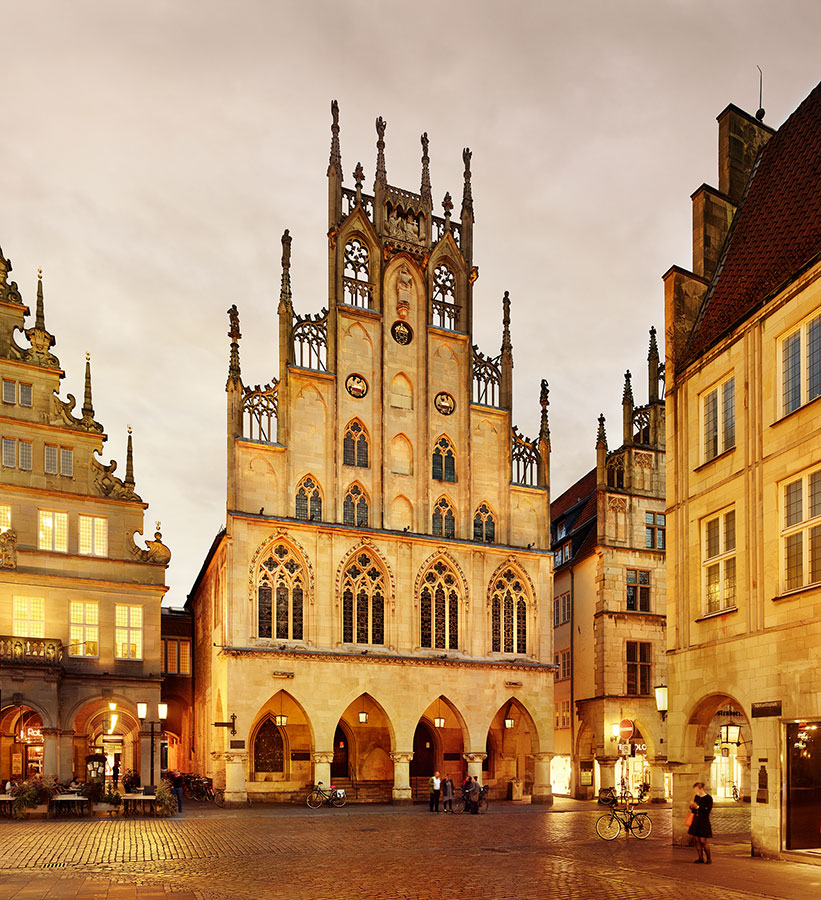
Münster, North Rhine-Westphalia
The Peace of Westphalia was sealed in Münster’s town hall.

Peace Route near Telgte, North Rhine-Westphalia
Today, cyclists are on a country lane near Telgte on the Peace Route. Back then, riders galloped back and forth here between Münster and Osnabrück with important information. The Emperor had set up a special imperial postal line between the two negotiating locations for the reliable exchange of news.
5. Dichter und Denker
Thinkers are usually pioneers of new ideas. They question traditional norms and create social dynamics.
From the knight Eike von Repgow, who wrote the first German law book (the Sachsenspiegel), to Albrecht Dürer, the natural scientist Johannes Kepler, Schiller and Goethe, to the Bauhaus, who made Dessau an architectural laboratory and a centre of attraction for young people from all over the world.

Wolframs-Eschenbach, Bavaria
The quiet Franconian town near Ansbach is the birthplace of Wolfram von Eschenbach. The medieval minnesinger and great poet created Parzival by 1210. The epic verse novel about the search for the Holy Grail inspired Richard Wagner to write an opera.

Albrecht Dürer
The half-timbered building below Nuremberg’s imperial castle serves Albrecht Dürer from 1509 as his workshop and home, as a shop window and salesroom.

Johannes Kepler
With the monument, Weil der Stadt in the district of Böblingen honours its famous son. The astronomer discovered the rules according to which the planets revolve around the sun – Kepler’s laws.


Johann Wolfgang von Goethe
Gingko tree planted by Goethe in the botanical garden in Jena. Goethe used the garden for botanical studies and as a muse for poetry. In 1794 he had it redesigned by order of his duke. The latter had given his Privy Councillor in Weimar a green gift. At the garden house in the park on the Ilm, Goethe let off steam as a gardener.

Schillerhöhe in Marbach
Places of poetry can be so beautiful. On the Schillerhöhe in Marbach, a large area is dedicated to it. From the monument, Friedrich Schiller, the town’s great son, looks down on the Schiller National Museum. It towers over the Neckar like a castle.
To the left, David Chipperfield’s Museum of Modern Literature with its reduced forms seems downright modest – in contrast to its magnificent content. Visitors can view original manuscripts of 20th and 21st century literature, such as Döblin’s Berlin Alexanderplatz or Kafka’s The Trial.
The German Literature Archive Marbach on the right side of the park, on the other hand, attracts scholars from all over the world with its 1400 writers’ estates and is involved in international research projects.

Loreley Rock in the Upper Middle Rhine Valley
The steep rock at the bend in the Rhine near St. Goar has been the undoing of many sailors. The site of the accident has always inspired the imagination of storytellers. In 1801, Clemens von Brentano was the first poet to sing of the mountain and the beautiful enchantress who dwells on it in a ballad. Heinrich Heine, however, made the Loreley famous with his song set to music by Friedrich Silcher.

Documenta in Kassel
The documenta started in 1955 to rehabilitate the previously ostracised artists and soon became the most important exhibition for contemporary art worldwide. Parthenon of Books by Marta Minujin and the exhibition hall Fridericianum at documenta 14.
6. Tod und Verderben
German soil is soaked in blood. Numerous battlefields remind us of the slaughter to this day. The decisive battle of the Peasants‘ Wars took place near Frankenhausen in Thuringia in 1525. The Battle of the Nations near Leipzig in 1813, with almost 100,000 dead, decided Napoleon’s defeat. The battles in the Hürtgenwald on the Westwall and on the Seelower Heights outside Berlin sealed the end of the Nazi regime.
The Nazis perfected the mixture of mass seduction and terror. The Nuremberg Nazi Party Rally Grounds, for example, served as a propaganda site for the psychological preparation for the rupture of civilisation that ended with the killing of entire populations and the invasion of half of Europe.

Witch hunt – Zeil am Main in Bavaria
The church tower of St. Michael stands high above the half-timbered houses of Zeil am Main. In the 17th century, over 400 people were burned as witches and devil worshippers in this tranquil wine town. The town tower on the left served as a dungeon and torture site. Today, a documentation centre in the witch tower recalls the excesses.

Battle of the Nations Leipzig 1813
The Monument to the Battle of the Nations shines in the distance like a graveyard light. Between 15 and 18 October 1813, Emperor Napoleon and his troops fought at the gates of the city against a coalition of Prussia, Russia, Austria, England and Sweden.
At the end of the battle, Napoleon lost control of Europe. Of the 600,000 soldiers, more than 90,000 died in the fighting and several thousand more in the days and weeks that followed.
Napoleon’s troops included Frenchmen as well as many soldiers from his satellite states consisting of Saxons, Poles, Badeners, Württembergers, Hessians, Bavarians, Westphalians and Italians.
The Battle of Leipzig was the largest and bloodiest battle in world history to date.

Buchenwald concentration camp memorial on the Ettersberg near Weimar in Thuringia.
Groups of pupils stand on the highest point of the roll call square of Buchenwald concentration camp, just as the SS commanders once did. 20,000 prisoners had to line up here for roll call every morning and every evening after hours of forced labour.


Kongresshalle in Nürnberg.
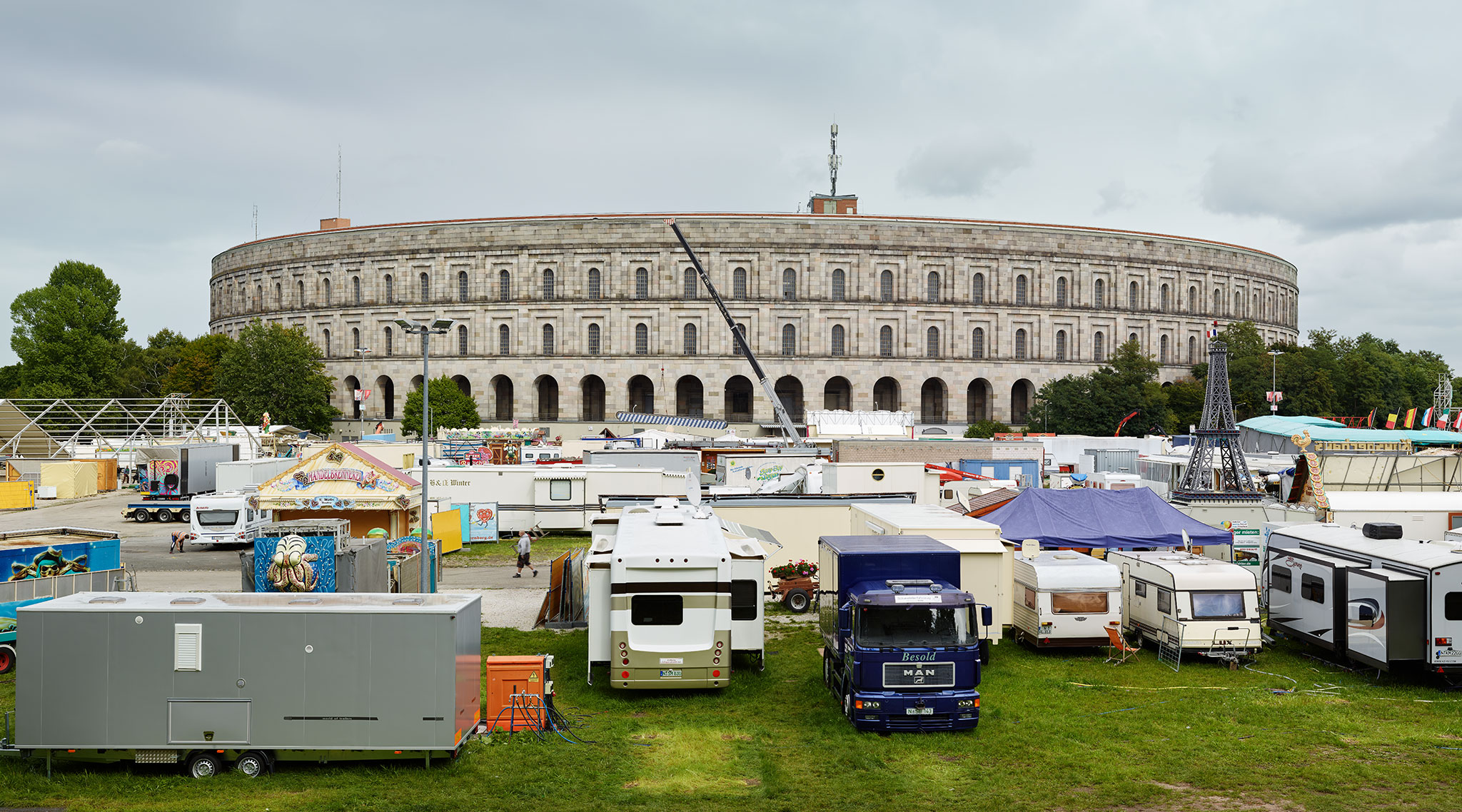
Nuremberg has converted the north wing of the monstrous Nazi complex into a documentation centre – one of the best contemporary history museums in the country. Nowhere is the construction megalomania of the National Socialists still as evident today as on the former Nazi party conference grounds in Nuremberg. The Congress Hall was deliberately intended to be reminiscent of the Colosseum in Rome and to provide space for 50,000 people. However, the building was never completed and is only half as high as planned.

Battle in the Hürtgen Forest
A blasted bunker on the Ochsenkopfweg near Raffelsbrand in the northern Eifel is a reminder of the battle in the Hürtgenwald between the Wehrmacht and the US Army.
From October 1944 to February 1945, a bitter war of position took place in the forests – one of the most costly and cruel battles in the history of the US Army. It was the longest battle in the Second World War on German territory.
Ernest Hemingway was there as a war correspondent and processed the horror of the fighting in the novel “Across the River and into the Woods”.

Battlefield in the Oderbruch – Seelow Heights, Brandenburg
Battle for the Seelow Heights. Two rainbows end in the Oderbruch, where tens of thousands of Russians and Germans shed their blood in the battle for Berlin. The advance of the Red Army led to fierce battles with the Wehrmacht from 16 to 19 April 1945. The result was the largest battlefield on German soil at the end of the Second World War. Even today, traces and relics of the fighting can be found in many places in the Oderbruch.

Georg Elser
The Georg Elser sculpture by the artist Friedrich Frankowitsch commemorates the failed Hitler assassin of 8 November 1939 at Königsbronn railway station.
In autumn 1938, Elser decided to eliminate the National Socialist leadership by a bomb attack in the Bürgerbräukeller in Munich in order to prevent the impending war. The bomb detonated as planned, but Hitler and his entourage had left the place earlier than planned. Only thirteen minutes were missing.
Georg Elser himself was arrested in Constance on the night of 8 November 1939 as he tried to leave for Switzerland. He was first held in Sachsenhausen concentration camp and then in Dachau concentration camp as a “special prisoner of the Führer” and was murdered shortly before the end of the war. In post-war Germany, his foresight and courage were concealed for decades and remained unappreciated for a long time.

Inner German border, Mödlareuth, Thuringia – Bavaria
An open-air museum with the Wall and watchtowers in Mödlareuth recalls the history of the divided village until German reunification. The border ran right through the middle of their “little Berlin”.
7. Hopfen und Malz
Agrarnation Germany. From the first cultivation of the landscape to the new wilderness.
Arable farming ensured the survival of the population. The Romans cultivated the first vines on the Moselle and Rhine. Monks developed the cultivation methods further.
Beer brewing also goes back to the monks‘ love of experimentation. Frederick the Great reshaped a landscape and had the Oderbruch, then a huge swamp, reclaimed and settled with immigrants.
The farmers in the Dithmarscher Land benefited from industrialisation and the resulting rural exodus. The area became the largest cabbage-growing region in Germany because of the great demand for vitamin-rich sauerkraut.
The forest as a German place of longing has been the subject of sharp political disputes for 50 years. The first German national park is an impressive example of the creation of new wilderness.

Kaiserstuhl vineyards near Oberbergen
The Kaiserstuhl is mainly covered by a layer of loess, formed by drifts of Rhine mud during the last ice age. Viticulture shapes the landscape of the Kaiserstuhl and has been repeatedly altered by man since its settlement. Since the 1960s, deep and, if possible, rectangular terraced areas with high slopes have been created on the slopes.

Moselle Bend near Bremm
The climatic conditions satisfied the Romans halfway when they came to the Moselle and Rhine after the subjugation of Gaul. They planted the first vines 2000 years ago. Later, monks developed the cultivation methods further.

Vineyards in the Ahr Valley
Steep vineyards of the Mönchhalde near Mayschoss on the Ahr.

Weltenburg Monastery
Weltenburg Abbey is located at the Danube breakthrough, an imposing narrows of the Danube in Bavaria. The Benedictines have been producing barley juice at the abbey since 1050, making it the oldest monastery brewery in the world. In the Middle Ages, the nutritious drink was an important supplement to the often meagre meals. Boiling the beer wort also killed germs. This made it a supposedly healthy drink for children, especially since the alcohol content was lower compared to today’s beer.

Einbeck, Lower Saxony
In the 14th century, beer was the most important export of the Hanseatic town of Einbeck. The brewers lived in richly decorated half-timbered houses with large gates for the brewing pots. They sold their beer as far away as Amsterdam, Riga and Venice. The beer was brewed to a particularly high percentage so that it could be kept for a long time. Because the Munich brewers searched in vain for a recipe for the strong beer, they hired a brewer from Einbeck in the 17th century. This is how Einbeck-style beer came to Bavaria: Bock beer.

Drainage of the Oderbruch
On 2 July 1753, the Oder flowed into its new artificial bed here at Güstebieser Loose in Brandenburg. The 19 km long canalisation was the prerequisite for draining the Oderbruch. Frederick II had the swamp turned into fertile farmland. With this mammoth project, the enlightened monarch brought thousands of immigrants to underpopulated Prussia and reshaped a landscape. Neulietzegöricke was the first village Frederick II had built for the new immigrants.


Cabbage field in Dithmarschen
The sky is wide in the Dithmarscher Land and so are the cabbage fields like here near Meldorf. The vitamin-rich vegetables ripen particularly well in the fertile and rainy marshland on the North Sea coast. Since industrialisation caused more and more rural residents to give up their vegetable gardens and move to the cities, the area has risen to become Germany’s largest cabbage-growing region.

Cabbage field on the Filder plain
Cabbage field at Stuttgart Airport. Vegetables have been grown on the fertile loess soils since the late Middle Ages.

Spelt field in the Bauland
The countryside in northern Baden-Württemberg has been home to spelt for centuries. Farmers harvest it semi-ripe as green spelt grain as early as July. This nutritious and tasty type of wheat used to help them through the lean weeks of the harvest season, when the previous year’s supplies had long since been used up.
8. Im Sinne des Erfinders
Industrialisation was the hour of the inventors in Germany.
The Irish engineer William Thomas Mulvany founded the first collieries in Gelsenkirchen, Castrop-Rauxel and Dortmund. Today, as representative industrial monuments, they are reminders of the great days of coal mining.
In 1888, Bertha Benz got behind the wheel of her husband’s car and demonstrated the suitability of his vehicle to the critical public on a 100-kilometre overland journey from Mannheim to Pforzheim.
Part of the modern age is the development of new transport routes. We show selected examples of the logistical art of engineering. The Göltzschtal viaduct, the largest brick bridge in the world, is just as much a part of this as Berlin’s Tempelhof Airport or the Mittelland Canal. Germany’s longest artificial waterway even crosses the Elbe as a bridge in places.

Old waterworks in Bautzen, Saxony.
The water tower or Alte Wasserkunst supplied the city of Bauten with drinking water from the Spree River flowing below the city walls. In order for the water to be piped to the highest point of the city at the Fleischmarkt square, the water tower’s elevated tank had to be higher.

Göltzschtal Bridge in the Vogtland
With 98 arches, it spans the Göltzsch valley in Saxony between Reichenbach and Netzschkau. The material for the world’s largest brick bridge presented itself to the builders in the middle of the 19th century. Bricks were fired by numerous distilleries due to large clay deposits in the region and were easy to procure. To this day, trains on the Saxony-Franconia Main Line between Dresden and Nuremberg cross the 78-metre-high and 574-metre-long structure.

Erin Mine, Castrop-Rauxel.
The wheels on the winding tower in Castrop-Rauxel have been standing still since 1983. Today, the structure is an industrial monument, with which the city commemorates the Irish coal miner William Thomas Mulvany.

Zeche Zollern in Dortmund
The Art Nouveau portal leads into the machine hall of the Dortmund Mine.

Bertha Benz Route
In August 1888, Bertha Benz and her two sons undertook the first long-distance journey in the automobile developed by her husband Carl Benz (Benz Patent Motor Car No. 3) from Mannheim via Heidelberg, Bruchsal and Weingarten to Pforzheim. On the return journey three days later, she drove a different route from Pforzheim via Bretten, Forst, Hockenheim and Schwetzingen back to Mannheim due to the steep gradients. Her average speed was between 15 and 18 km/h. Today, motorists can retrace the route themselves.

Canal bridge of the Ludwig-Danube-Main Canal
At Schwarzenbruck, the Ludwig-Danube-Main Canal has been crossing the Schwarzach Gorge since 1845.

Canal bridge of the Mittelland Canal near Magdeburg
As early as 1934, ground was broken for the construction of a bridge that would carry the Mittelland Canal over the Elbe near Magdeburg. What was prevented by war and German division was completed after reunification. Since 2003, Europe’s longest canal bridge (918 metres) has been crossing the Elbe.

Einstein Tower in Potsdam
With its concave forms, the observatory on Telegrafenberg was a revolutionary building in 1920. The architect Erich Mendelsohn had built it for a new type of solar telescope.

Radio telescope Effelsberg
Since 1972, the Effelsberg radio telescope in the Eifel has been listening into the depths of the universe. When it was commissioned, it was the largest of its kind. One advantage of radio astronomy is that radio signals are hardly absorbed by dust clouds.

Radio telescope Effelsberg
The most distant objects in space are measured and observed: pulsars, black holes, planets, suns, supernovae, black holes, molecular clouds and magnetic fields. Even at a distance of over 11 billion light years, the researchers found water in their space-wide search. Today, the radio telescope belongs to the Max Planck Institute for Radio Astronomy in Bonn.
The Book

Deutschland - eine Reise durch die Zeit
Texte von Sabine Böhne
Frederking & Thaler Verlag, München
2018
Hardcover mit Schutzumschlag,
240 Seiten
Format 26,8 x 28,9 cm, 115 Fotografien
ISBN: 978-3-95416-187-4
Sprache: Deutsch
Ausverkauft
All other Series
- Info
- Landscapes
- The Lightworks
- Portraits
- Projects
From here, you can easily navigate to all the different portfolios and image series.
- Alpine Passes
- Alpine Railways
- Germany - Journey through time
- German Landscapes
- Seascapes
- Dutchscapes
- Iceland Landscapes
- The Normans
- The Land of the Cathars
- Monument Valley
- The Vikings
- Winnetou Landscapes

Alpine Passes

Alpine Railways
Germany - Journey through time
German Landscapes

Seascapes

Dutchscapes

Iceland Landscapes

The Normans

The Land of the Cathars

Monument Valley
The Vikings
Winnetou Landscapes




- Ghost Towns of the American West
- Ancient Greece
- British Abbeys
- The invisible Camp
- German Bedrooms
- Göbekli Tepe
- The Celts
- Lost Places
- The Limes
- Caves of the oldest Ice Age Art

Ghost Towns of the American West

Ancient Greece

British Abbeys

The invisible Camp
German Bedrooms

Göbekli Tepe

The Celts

Lost Places
The Limes

Caves of the oldest Ice Age Art